As a student, acknowledging your sources is an important skill and habit to foster throughout your academic career. Sheridan's Academic Integrity Policy states that, "Sheridan expects that Students will only claim credit for their own ideas, writing, projects, and creations." As a result, acknowledging where others have contributed, or non-original ideas have been included in your work ensures your academic integrity is maintained. Responsible use of generative AI tools includes avoiding unfair academic advantage in any academic work. Learning how to maintain your integrity even in challenging circumstances will help you succeed not just in college, but in your future career as well.
First, let's be clear.
Choose from common types of acknowledgement.
Citations
When quoting, paraphrasing, or inserting content directly from a generative AI tool, provide citations following an established citation style. Find examples for generative AI citations from the Library citation guides:
Learn how to integrate summaries, paraphrases, and quotes more effectively in your writing.
Declarations
Declarations may be required when generative AI tools are used to assist a portion of the creation of the work (e.g., brainstorming, identifying sources, editing). Declarations are often added as a brief acknowledgement at the end of the assignment (before the references or works cited) or appended on a separate page (after the references or works cited) along with the full transcript of the conversation with the chatbot. Always be sure to follow the appropriate style requirements for appendices as outlined in your style guide (e.g., APA Style).
Declarations should:
- Identify the Tool: Specify the name of the GenAI tool used, such as ChatGPT, Copilot, or Claude.
- Describe the Task: Explain what tasks the AI tool helped you complete, such as brainstorming, writing sections of text, editing, or generating images.
- Provide Prompt Details: If the specific prompt you used is relevant to the context, include it in your acknowledgment.
- Explain Modifications: If you edited or modified the AI's output, indicate the extent of your edits in your acknowledgment.
Example Acknowledgement: Copilot by Microsoft Corporation was used to locate organizations related to this topic using the prompt "What organizations are involved in creating standards for academic integrity?" The list of organizations provided by Copilot were investigated and selected based on relevance to the topic.
For a more formalized acknowledgement statement, follow the AID Framework:
Transcripts
Whenever you use a generative AI tool for academic work, saving the transcripts of your conversation(s) as you work can be helpful, even if not required by your professor.
In cases where transcripts are required by your professor, transcripts are most often added with a declaration as an appendix to your written assignment. Always be sure to follow the appropriate style requirements for appendices as outlined in your style guide (e.g., APA Style).
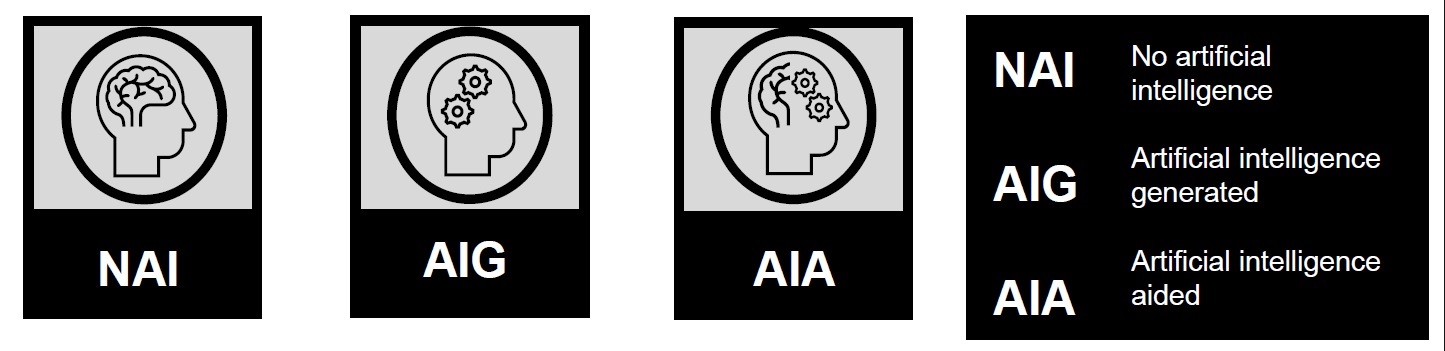
In some cases, such as creative works, presentations, webpages, etc., you may be able to insert a simple badge, often in the footer of the document or presentation, to indicate to what extent generative AI was used. For example:
Learn More
Chat with Us if you have any questions about using generative AI tools.
